|
Quick Reference
Management Practices
| Climate
Change Impact on Forest Management
|
Manage Forest Species
|
Forest
Soils
Management Practices
What is Sustainable Forestry? by Ron Eckstein:
Sustainable Forest Management
is
the
practice of managing dynamic forest ecosystems to provide
ecological, economic, social, and cultural benefits for present and
future generations. 2) The practice of meeting the forest resource
needs and values of the present without compromising the similar
capability of future generations. 3) The stewardship and use of
forests and forest lands in a way, and at a rate, that maintains
their biodiversity,
Principles of Ecological Forestry:
New forestry within an ecological context: Forests managed for
wholeness and complexity, rather than efficiency and simplicity;
Emphasis on structure and function, rather than a particular
product; Silviculture is a working hypotheses with uncertain
outcomes; Adaptive management approaches are monitored and
continually refined.
Wisconsin Managed Forest Law Details:
MFL is a landowner incentive program that encourages sustainable
forestry on private woodlands in Wisconsin. Together with landowner
objectives, the law incorporates timber harvesting, wildlife
management, water quality and recreation to maintain a healthy and
productive forest. Sustainable forest management benefits
Wisconsin’s economy, hunting, fishing, wildlife, recreation, soils,
waterways, and air quality, and renews our beautiful forests for
everyone to enjoy.
WDNR Division of Forestry:
Links to the Wisconsin DNR forest news and information concerning
the sustainable management and protection of this precious resource
so that it continues to provide a host of ecological, economic and
social benefits for years to come. These resources are available to
help landowners, loggers and natural resource managers understand
and implement forestry best management practices (BMPs).
Best Management Practices Landowner Guides:
These resources are available to help landowners, loggers and
natural resource managers understand and implement forestry best
management practices (BMPs).
Wisconsin Forest Management
Guidelines - WDNR:
The
Wisconsin Forest Management Guidelines (FMG)
celebrates the wealth of our forest resources and
emphasizes our responsibility to care for them. It
outlines practical, site-specific considerations
that land managers need to take into account when
they plan and carry out forestry operations.
University of Wisconsin Forestry Facts:
University of Wisconsin has issued over 100
fact sheets documenting forestry practices. Sample subjects
are: Best practices; Hiring a consulting Forester; How to manage red
pine; Understanding the sample timber sale contract; Filling out a
cutting Notice (MFL).
University of Wisconsin Forestry
Extension Programs:
Information is
provided on a variety of topics from hands-on information to
successfully manage for recreation, wildlife, and timber harvest to
the history of Wisconsin’s forests.
A very comprehensive web site
offering detailed information on forest
management and a series of educational opportunities for the
woodland owner.
Forest* A *Syst: Tools to Manage your Private
Forest Land:
Trees take a long time to grow, so today's decisions have long-term
impacts on forests and water quality. Forest*A*Syst helps you plan
what you want your forest and wooded acreage to be and set out the
steps you need to take to get there.
Forest Images:
Image
categories: Forest Pests: Trees, Plants, and Stand
Types; Silvicultural Practices; Urban Forestry;
Wildlife; People, Places and Scenes.
Wisconsin
Forests: The Private Landowner's Handbook:
Of the state’s nearly 17 million acres of
forested land, private landowners and their families own over 50
percent. Those very woodlands are the source of Wisconsin’s
wildlife habitat, clean air and water, recreational
opportunities, and the timber and wood products that build our
communities, heat our homes, and provide for a diverse forest
products industry with economic returns. All of us share in the
responsibility to ensure the health and vitality of those
forests – not only for today, but also for the generations of
citizens of the future. It is a very large responsibility, and
not one to be taken lightly.
Caring for Wisconsin Woodlands:
Current woodland topics, Learn About Your Land
classes, webinars, publications and information that will help you
meet your goals.
Sign up for Wisconsin Forestry
Newsletters:
Sign up for Wisconsin Division of Forestry
Newsletters
through e-mail by
clicking here.
Wisconsin Forest Inventory and Industry
Trends:
This site contains information on current
conditions and trends in the forest products industry and in the
forest resources of Wisconsin. These reports are produced
annually or periodically by the Wisconsin Department of Natural
Resources Division of Forestry, Forest Products Services
Program. Some reports are developed through the use of data from
or in collaboration with the U.S.D.A. Forest Service.
Wisconsin
Urban Forest:
Like electricity and water, an urban tree
canopy is part of a community's infrastructure. Well-managed
urban forests provide services such as energy conservation,
economic vitality, improved air quality, reduced stormwater
runoff, carbon sequestration and enhanced beautification.
Forest Health News Updates:
Wisconsin's forests are generally in good
health, yet numerous native and exotic insects and diseases and
extreme weather events threaten their health annually. The Forest
Health Protection staff provides insect and disease management
assistance on 16 million acres of state, private, industrial and
county forest lands.
Wisconsin
Forestry:
Wisconsin's 17 million acres of
forestlands and millions of urban trees significantly enhance
the quality of life in our state. The Wisconsin DNR dedicates
itself to the sustainable management and protection of this
precious resource so that it continues to provide a host of
ecological, economic and social benefits for years to come.
Learn about Wisconsin forestry by exploring the topics below and
by visiting the Division of Forestry publications catalog,
external news site and forestry videos.
Forest Fire Danger and Burning Permits:
It is important to have your written and
signed
annual burning permit
available while burning and follow all restrictions listed on both
sides of the permit.
Livin' by the Lake:
Melanie B. Fullman,
District Ranger, US Forest Service, Ottawa NF, discusses important shoreline
standards and guidelines for a natural shoreline
that minimizes pollution, provides greater protection from erosion, and
supports a greater number and diversity of wildlife.
DNR Division of Forestry
Operations Plan and Strategic Direction:
The Operations Plan allocates staff and fiscal
resources to produce the intent of the Division's Strategic
Direction.
Wisconsin Woodland Owners Association:
WWOA has many publications, references and website
links available to woodland owners.
Woodland
Stewardship: The
Forest Stewardship Program (FSP) of the U.S. Forest Service
works in partnership with state forestry agencies, cooperative
extension, and conservation districts to connect private
landowners with the information and tools they need to manage
their forests and woodlands.
Argonne Experimental Forest: The
Argonne was one of the locations where experiments were done to
evaluate the impacts of forest management activities on growth and
yield and this data was used to create growth and yield models for
most northern hardwood timber types in Wisconsin and it was these
models and these experiments that gave us the stocking charts we use
to guide management. It is located just south of Three Lakes on
highway 32 and has a very nice interpretive trail that takes about
two hours to walk.
Forest Stewardship Council: The
Forest Stewardship Council sets standards for responsible forest
management. A voluntary program, FSC uses the power of the
marketplace to protect forests for future generations. Some people
feel the best way to prevent deforestation is to stop using forest
products. In reality, people use forest products every day. For
example, the average American uses nearly six trees worth of paper
each year. So FSC harnesses market demand to ensure forests are
responsibly managed. Because FSC is the gold standard in forest
certification, it is the only system supported by groups such as
WWF, Sierra Club, Greenpeace, Natural Resources Defense Council and
National Wildlife Federation.
More trees best way to fix climate, study says: The
most effective way to fight global warming is to plant lots of
trees, a study says. A trillion of them, maybe more.
Wisconsin initiative on Climate
Change:
The Wisconsin Initiative on
Climate Change Impacts (WICCI) is a statewide collaboration of
scientists and stakeholders formed as a partnership between
UW-Madison’s Nelson Institute for Environmental Studies and the
Wisconsin Department of Natural Resources. WICCI’s goals are to
evaluate climate change impacts on Wisconsin and foster
solutions.
Forest Products Labratory: For
almost 100 years, our mission has been to use our Nation's wood
resources wisely and efficiently, while at the same time keeping our
forests healthy. Our research began with preserving railroad ties,
and now we are venturing into nanotechnology and finding ways that
our research can contribute to mitigating the impacts of climate
change. The FPL research staff has the experience and expertise
needed to make us world renowned among forest products research
organizations and an unbiased source of information. FPL researchers
have longevity, with an average of 20 years of experience in their
related fields.
THE TRAINING OF A FORESTER BY GIFFORD
PINCHOT 1914 book.
"To the men whom
it really suits, forestry offers a career more attractive, it
may be said in all fairness, than any other career whatsoever. I
doubt if any other profession can show a membership so uniformly
and enthusiastically in love with the work. The men who have
taken it up, practised it, and left it for other work are few.
But to the man not fully adapted for it, forestry must be
punishment, pure and simple. Those who have begun the study of
forestry, and then have learned that it was not for them, have
doubtless been more in number than those who have followed it
through."
Click here to read the book.
Drone 1 Technology to plant vast forest
areas. Tree planting drones! Good idea.
Climate Change Field Guide For Wisconsin
Forests: Climate change is a growing
concern for Wisconsin’s forests. Foresters and landowners are
considering how to prepare for future conditions and evaluate
risks in the woods. This field guide is a quick reference on
climate change for northern Wisconsin forests. We hope it will
help foresters consider climate change risks together with local
site characteristics, and also that it will help people design
adaptation actions that help meet management goals.
Michigan Forest Health Highlights 2020:
From verdant upland hardwood forests to cool
cedar swamps to sun-drenched oak savannas, Michigan’s 19.3
million acres of forestland, about 4 million of which the DNR’s
Forest Resources Division manages, play an important role in the
Michigan way of life. Michigan’s forests are the heart of a $20
billion forest products industry and a $34 billion outdoor
recreation industry (learn more at Michigan.gov/DNR). Most of
the state’s large forests are in the Upper Peninsula and
northern Lower Peninsula. Monitoring and protecting this
resource from the effects of forest pests and diseases is an
important part of ensuring that we can enjoy the benefits of
forests today and into the future.
Glossary of Terms Relevant to the
Identification of Trees and Shrubs:
Learn about alternative leaves, ament, armament,
axillary bud ans muh, muh more.
Considering Framing and Construction
Lumber: Given the crisis in softwood
lumber, extreme pricing and short supply, it is our hope to help
readers wade through it all. PIF sees no shortage of raw
log-bolt material in our area, however the poor pulpwood markets
likely hold up sales that have a strong mix of log and pulpwood.
Also see
A guide to American softwood species
and
A visual guide to Softwoods Species and
Grades
Climate Change
Impact on Forest Management
FOREST CARBON: An essential natural
solution for climate change: Your
forest has always provided tremendous personal and public
benefits, including clean water, wildlife habitat,
recreational opportunities, and forest products. Recently,
an additional forest benefit has been recognized: forests as
an essential natural solution for climate change.
Look to the
Land: Carbon Management in Forests and Grasslands:
Northern Institute of Applied Climate
Science Michigan Technological University Presentation
Manage
Forest Species
Pine
How to look for white pine bast scale and
Caliciopsis canker:
The
association between a tiny insect and an inconspicuous fungus is
causing branch and sapling mortality. White pine bast scale
(WPBS; Matsucoccus macrocicatrices) and Caliciopsis canker
(caused by Caliciopsis spp.) are agents in an insect/disease
complex impacting white pines. WPBS seems to cause minimal
damage by itself. However, trees weakened and stressed by WPBS
appear to be more susceptible to infection by Caliciopsis spp.,
which may infect trees through the tiny feeding wounds left by
WPBS.
The causal fungus of Caliciopsis canker is
considered native to North America. In Wisconsin, it has been
identified in multiple northern counties (Bayfield, Iron, Price,
Vilas, Oneida, Forest, Marinette, and Menominee) and two west
central counties (Jackson and Eau Claire) (Figure 2). It is
likely that the fungus is present in other Wisconsin counties as
well.
Click here to read more on the canker.
Red Pine Pocket Mortality:
Red
pine pocket mortality, caused by a complex of insects and the
fungi Leptographium terrebrantis and L. procerum
was first identified in Wisconsin in 1975. National distribution
of this syndrome is unknown. Thinned, plantation-grown red pines
between the ages of 30-45 are most likely to show symptoms of
this syndrome.
Heterobasidion
root rot:
Planning to cut pine trees on your property? Then you need to
know how to protect your woodlands against the “circles of
death” of Heterobasidion root rot, the most damaging
disease in temperate conifer forests of the world which has
become an epidemic in Wisconsin. Thinning of pine plantations or
cutting of conifer trees can expose your woodland to this deadly
disease. Failure to aggressively respond to the discovery of
this lethal pathogen has threatened sustainable management of
Wisconsin's pines and other conifers in commercial forests, and
also endangers trees in recreational woodlands and in wooded
residential and vacation properties.
Jack Pine Budworm: There
has recently been incidence of the jack pine budworm, a cyclic
insect pine pest, in many parts of PIF’s membership area.
Jack pine is the preferred host of this pest, which attacks
primarily those trees 20 years and older, but budworm will also
spread into stands of red pine in areas that are heavily
infested.
Armillaria Root Rot: This
fungus is common throughout the Lake States in red pine
plantations. Damage is especially severe on trees under stress
and trees growing in cutover hard-wood stands. Armillaria causes
a decay, seldom extending more than a few feet above ground. It
kills trees by girdling at the root collar.
Oak
Wisconsin Oak Wilt:
Oak
wilt kills thousands of trees each year in forests, woodlots and
urban areas. Oak wilt can even attack and kill healthy trees.
The disease is a particularly serious problem for species in the
red oak group such as northern red, northern pin and black oaks.
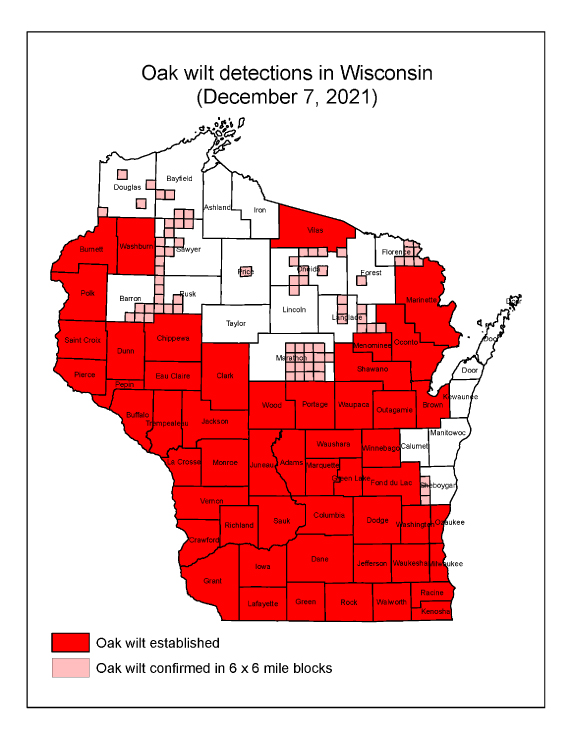
In addition, click here for the results of a
study
of oak wilt detection in Wisconsin as of December 7, 2021.
Wisconsin Oak Wilt:
Learn if your property is at risk, how to reduce the
spread of oak wilt in a forested area, how to know if a tree has
oak wilt and much more.
Oak Wilt Management - What are the Options:
Thousands of Oaks in woodlands and urban settings
die from oak wilt every year. Widespread in Wisconsin,
Minnesota, and Michigan, the disease is caused by the fungus
Ceratocystis fagacearum. Because trees in the red oak group fall
prey to the disease most often, the publication focuses on the
red oak group.
Twolined chestnut borer:
Adult twolined chestnut borers
primarily attack oaks that are damaged by drought or trees that
are suppressed or declining. Urban oaks that suffer stress from
trunk and root injury, soil compaction, and changes in soil
depth are equally vulnerable to attack by this pest.
Collapsing foundations: The ecology of the
British oak, implications of its decline and mitigation options:
Oak (Quercus
spp.) is declining globally due to a variety of pests, pathogens
and climate change. Assessments of the impact of losing keystone
species such as oak, should include the impact on associated
biodiversity and ecosystem functioning, and consider mitigation
options. Here, we assess the potential ecological implications
of a decline in Quercus petraea/robur within the UK. We collated
a database of 2300 species associated with Q. petraea/robur of
which 326 were found to be obligate associates (only found on Q.
petraea/robur).
Preparing for life after peak oak:
It’s
no coincidence that oaks appear so prominently in premodern
European mythology. Thousands of species are known to live among
their branches and in their bark; their nuts are foundational to
forest food webs. A centuries-old oak is practically an
ecosystem unto itself, and though people no longer worship
beneath their boughs, oaks remain appreciated and even beloved.
Spruce
Spruce decline in Wisconsin:
Spruce decline has been advancing in Northcentral Wisconsin
since about 1988, with symptoms progressing from the ground up,
and from the inside of the crown outward. Symptoms
included very poor live crown ratios and loss of needles
throughout the crown, but significantly worse on the lower
portions of the crown.
Maple
Sugar Maples Trouble?: As
many readers know, sugar maple is one of the most important
timber species in the North Woods.Unfortunately, for the past
several years, reports of dieback have been coming from multiple
locations across the UP, northern Minnesota, and northern
Wisconsin.
Evidence
of damage from exotic invasive earthworm activity was highly correlated
to sugar maple dieback in the Upper Great Lakes region.
Sugar maple in
the western Upper Great Lakes region has recently been reported with
increased crown dieback symptoms, prompting investigation of the dieback
etiology across the region. Evaluation of sugar maple dieback from 2009
to 2012 across a 120 plot network in Upper Michigan, northern Wisconsin,
and eastern Minnesota has indicated that forest floor disturbance
impacts from exotic invasive earthworms was significantly related to
maple dieback.
Click here to read the full article.
Sugar Maple Syrup: Hey
Maple Syrup producers and lovers...perhaps you are already aware of the
science behind maple sap flow, but I found this 1 hour webinar
fascinating. It was this week's lecture put on by the Urban Forestry
Today website that offers monthly lectures on various forestry related
topics. It also shows some commercial, high tech operations in Vermont.
Amazing.
North American Maple Producers Manual -
Third Edition: North American Maple Syrup Producers
Manual is now available for download! Send a blank email to
mapleproducersmanual@gmail.com and you will receive a link to view and
download the 434-page Manual.
Ash
Emerald Ash Borer: Emerald
ash borer was found in southeast Wisconsin in August of 2008.
The purpose of this website is to provide clear and timely
information about EAB to those affected by, or potentially
affected by, the insect's presence in our state.
Hemlock
Woolly Adelgid:
The two hemlock species found in eastern
North America, eastern hemlock (Tsuga canadensis) and
Carolina hemlock (Tsuga caroliniana), are susceptible and
seem to have little resistance to hemlock woolly adelgid damage.
Heavy infestations can lead to the death of the tree within 4 -
10 years, and trees are also weakened and made vulnerable to
attack by other insects and diseases.
Balsam Fir
Dead Foliage:
Symptoms:
wilting (wilted) new foliage, mostly in the lower 1/2 of crown
(looks like frost damage; or dead mature foliage on branches
that are oftentimes still with green cambium, mostly in the
lower 3/4 of crown; or dead tips (only distal few inches)
scattered around crown; or
tied foliage with pupal cases and lots of moths fluttering.
Butternut (Black
Walnut) Fir
Butternut Canker:
Butternut is being killed throughout its
range by Sirococcus clavigignentijuglandacearum, a fungus most
likely introduced from outside of North America. The fungus
initially infects trees through buds, leaf scars, and possibly
insect wounds and other openings in the bark, rapidly killing
small branches.
Basswood
Basswood Thrips:
Defoliation of basswood trees caused by introduced basswood
thrips. The introduced basswood thrips, thrips calcaratus, is a
recently recognized defoliator of American basswood in the Lake
States.
Birch
(help us provide more detail)
Evergreen Schrub
Death
and Taxes: the high cost of palatability for a declining evergreen
schrub.
In forest ecosystems woody shrubs face many
challenges in the struggle for survival and growth. In addition to
coping with the high-shade environment of the forest floor, in many
systems shrubs have to contend with the presence of mammalian
herbivores. Since these understory inhabitants spend their entire
existence within the reach of browsers, they must carefully balance the
allocation of limited resources among maintenance, growth, and defense.
When nutrients and light are readily available, fast-growing species
rapidly regrow tissues to compensate for herbivore consumption, but if
resources are limited, investment in defense may be the preferred
option.
Click here to continue to read article.
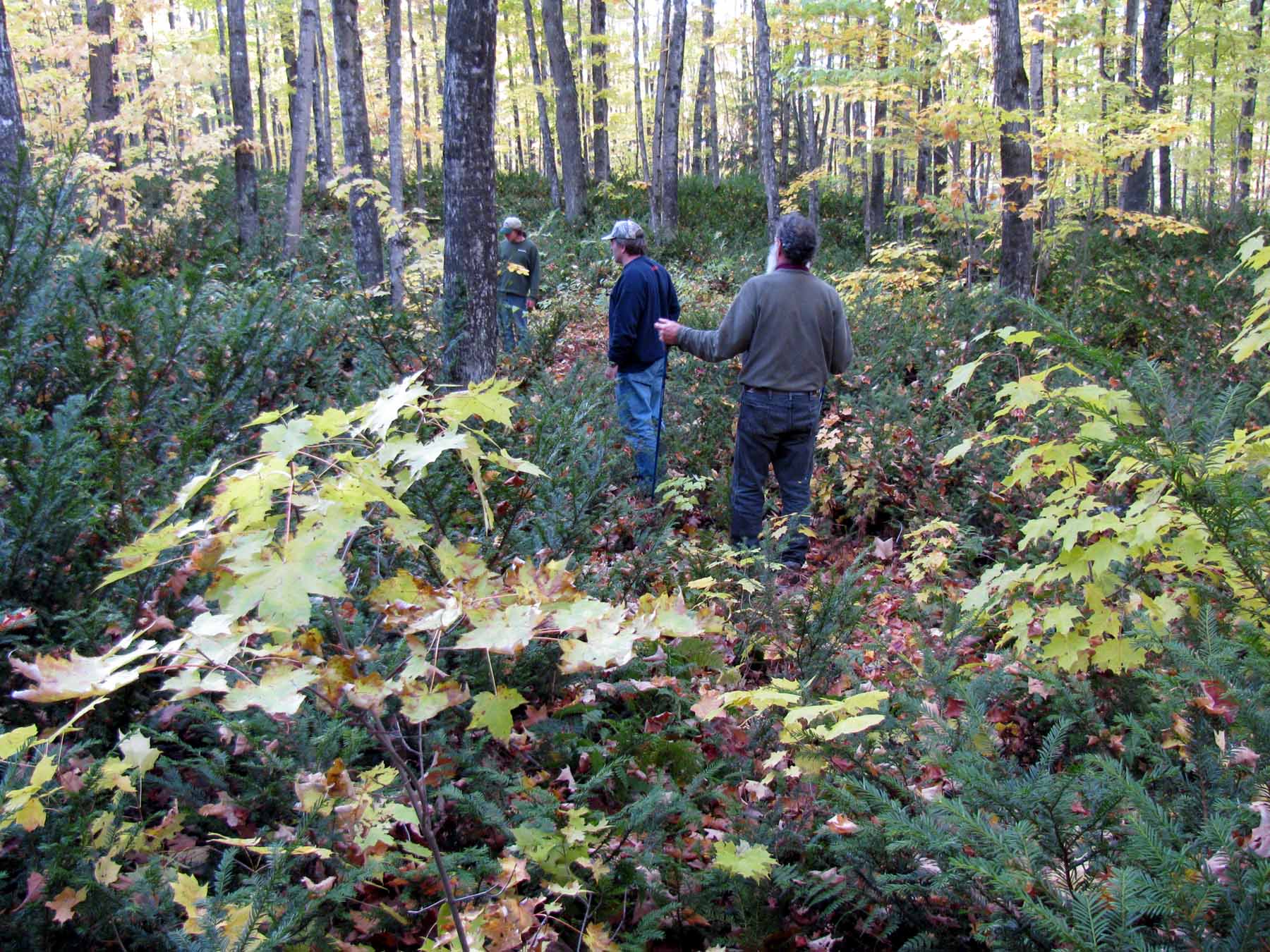
Extensive Canada Yew on Pilgrim River property
Articles on the ecology,
distribution, conservation and management of large old
trees:
2017 Conserving large old trees as
small natural features - BiolCons;
2016 The unique challenges of
conserving large old trees - TrendsEcolEvol;
2016 The ecology, distribution,
conservation and management of large old trees - BiolRev
DOI;
2014
New Policies for Old Trees: Averting a
Global Crisis in a Keystone Ecological Structure - ConsLett
In
many areas of the United States, the population density of
white-tailed deer has dramatically increased over the past
century to levels that are significantly greater than
presettlement estimates. Prolonged and selective overbrowsing by deer
has strong impacts on population-and community-level
processes. Here are several "Deer browse impact research
papers":
"The
legacy of deer overabundance: long-term delays in herbaceous
understory recovery";
"Historic
disturbance regimes promote tree diversity only under low
browsing regimes in eastern deciduous forest";
"Chronic
over browsing and biodiversity collapse in a forest
understory in Pennsylvania: Results from a 60 year-old
deer exclusion plot";
"Deer
herbivory reduces web-building spider abundance by
simplifying forest vegetation structure";
"On
the formation of dense understory layers in forests
worldwide: consequences and implications for forest
dynamics, biodiversity, and succession"
NRCS Soils:
Soils and Moisture are fundamental elements in
having a healthy forest. Soils
is part of the National Cooperative Soil Survey, an
effort of Federal and State agencies, universities,
and professional societies to deliver science-based
soil information.
|